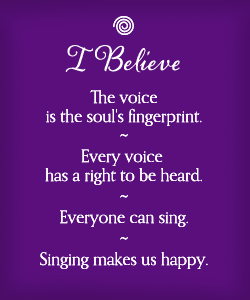
Explore the Permutations of Your Voice

Playing around with my voice

Playing around with my voice

Here’s a fun exercise to explore all of the permutations of your voice.

1) Brainstorm this question: What voice do you have and use or have and don’t use? For example, my list includes whiney, tired, needy, sexy, desperate, sad, loving, funny, light-hearted, assertive, snippy, breathy, held back, cross, frustrated and wise. Make an exhaustive list.

2) Pick one quality from your list, for example, “snippy.” Put a typical phrase to that, something short you have actually said before in that tone of voice. In an argument with my husband recently, I said in my snippy voice, “Are you listening?”

3) Say this phrase aloud several times exploring the full range of the vocal quality. As you repeat this over and over, you may notice a rap-like tune emerging. Go with it. Bang on the counter or your thighs to give it an accompanying beat.

4) Try another vocal quality from your list. Give it a phrase. Rap out the tune. Drum the beat.

5) String several together to make a song, a rap to amuse and connect you to you at this moment.

6) Have Fun! Let me know how this worked for you. I noticed the more I repeated my phrase, the sillier it became, taking all the sting and resentment out of it. It was amusing. I had fun doing it. Did you?

Hear My Voice

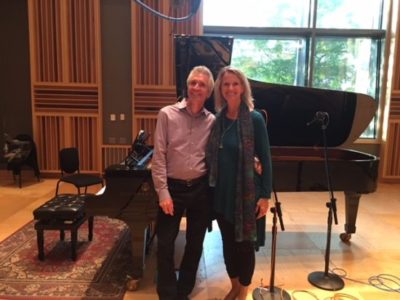
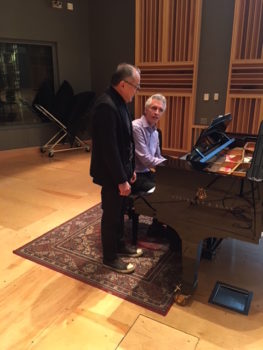
Julie Ward and I working on her solo, singing out!

Julie Ward and I working on her solo, singing out!

I heard a song last night by Emma’s Revolution called “Hear My Voice.” It’s a powerful reminder that a women’s voice can change the world.

We don’t always believe that. What I often hear from women is how afraid we are to speak up, to contribute vocally at work, to set positive boundaries, to value our needs and talents in assertive and collaborative ways. We are afraid of possible consequences – rejection, conflict, loss of connection, failure and success.

We need the voice of the feminine in the 21st century – empowered, connected, compassionate and wise. The challenges we all face are a result of disconnected, isolationist, fight-to-win thinking. We need both sides of our creative brains to solve our common challenges – the linear, strategic, analytic approach as well as the holistic, intuitive, empathic approach. The full strength of a woman’s voice is needed at this time to balance the centuries of one-sided control.

As I celebrate my 58th birthday, I realize that it is more important than ever that I speak up. I, too, have been afraid that speaking up might rock the boat and tip me out of my valuable connections. But what I find is, the more I speak and sing with my whole voice, the more connected I feel. Whatever the topic – challenges at work or at home, saving the environment, economic security, moving beyond war, or telling a friend you love them, connect with your core today and speak up with your own open-hearted strength!

In honor of summer officially starting on Monday, I am going to be writing this blog every other week for the next three months. Happy summer!

Singing is Essential!

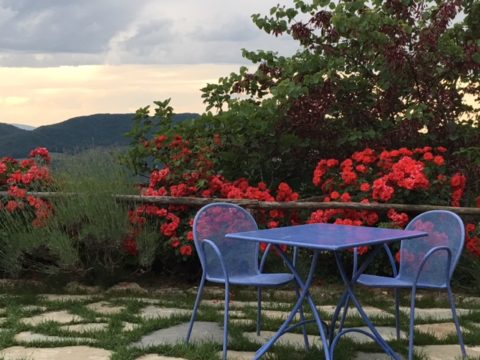
Outer voice reflecting inner voice in flowers.

Outer voice reflecting inner voice in flowers.

“Song is not a luxury, but a necessary way of being in the world… To give voice to what lives inside is what keeps all things possible.” Mark Nepo wrote this in The Book of Awakening. The idea that giving voice to our inner spirit empowers our outer lives is well known to monasteries, where several hours a day are spent chanting, but not to contemporary life. Yet, chanting, even for three minutes, changes our fundamental vibration, including our brain waves and blood pressure.

Singing is not a luxury. When we sing, we breathe deeper, leading to physical relaxation and a visceral sense of being centered and focused. The noisy judgments of our inner monologue take a rest. Our heart beats in harmony with the song we are singing. We feel more embodied, more connected to ourselves, present in the moment. Research has confirmed that when we are present, we are happier. Singing can only be done in the moment.

There we are, singing, present, breathing, aligning all the vibrations of our body in harmony with each other. The static, fears and judgments of the mind are stilled for a bit. We drop into the only moment we have – NOW. On your own or with others, it works every time. Singing is not a luxury. It is essential and free.

TRY THIS: Tone an [ooh] for 3 minutes. Breathe when you need to and keep toning the same vowel and pitch.  Let me know what you discover.

Ignite the Voice Within

Meditating in my field labyrinth on May Day.

Meditating in my field labyrinth on May Day.

This week was book-ended by labyrinths. In honor of May Day, the ancient holiday that calls in the long days of life growing again, I woke up my labyrinth by mowing its 7 circuits in the field behind my house. At the end of the week, I walked an 11-circuit labyrinth in Nashua for an event called Walk as One at One for World Peace on World Labyrinth Day.

Labyrinths have been used for centuries as spiritual meditative tools that allow walkers to connect with their inner soul voice. Finding our voice can be a challenge, especially in this time of technological distractions and the hurry sickness of our age. Labyrinths are designed to make us slow down. The path winds indirectly in to the center, which invites stillness and reflection. Then the path is retraced back out. Walking a labyrinth quiets the inner monologue creating space for our soul’s inner voice to be heard.

As the light lengthens, energizing plants, animals and humans to grow, find a local labyrinth and ignite the voice within. Here are a couple of resources to get you going.

www.nashualabyrinth.org/‎

www.bowmillsumc.com/RESOURCES/Labyrinth_brochure.pdf

http://www.labyrinthguild.org/index.php/newengland/locator

The Sound of Music

The springs are alive with the sound of music.

The springs are alive with the sound of music.

Last Sunday, I went with four friends to Sing Along with The Sound of Music at our local, independent Red River Theater in Concord. We watched the film and sang every song following the karaoke sub-titles. All kinds of voices were singing – from the playful pitch of children to the middle gusto of adults to cheerfully wobbly, older voices.  We all loved it.

The singing was not fine in any artistic sense, but it was lively, enthusiastic, and committed. In fact, in the beginning, we sang so lustily, that we got behind Maria because we couldn’t hear her. Listening carefully, we laughingly caught up to her crystalline call.

For three hours, we sang every word, climbed every mountain and followed our dream to sing like Julie Andrews. Singing is an instant bonding experience. What was most special about the afternoon was the connection we found with each other, an audience of mostly strangers yodeling, singing, hooting and laughing. We made a singing community; out of diversity, unity.

Perfect Is What Is!

Songweavers in concert

Songweavers in concert

Last week was bookended by Songweavers annual concert and a two-day Vibrant Voice workshop. I was bathed in music- focused, passionate and beautiful. Songweavers is a community chorus with a wide range of vocal experience, learning everything by ear, essentially memorizing the entire concert.

I have learned a very important life lesson in my years performing. Perfect is not a product in which goals bind people in a straight jacket of judgments, both from others and ourselves. Perfect is the process. Perfect is what is.
What was perfect about the Songweavers concert was the process of singing together once a week all year, rehearsing intensely the week before, learning all we could, including how to let go of mistakes and to sing in the moment. The result was a concert of joy – smiling faces, dancing bodies, and colorful women, happy to share our love of music with families and friends.

Mary Anne Radmacher said, “What joy there is when one gets to take part in the song of love itself.” That’s what Songweavers did in concert this month. What a wholehearted performance – focused, musical and joyful, the songs of love itself. Perfection is what is.

The Rhythm of Life

This article will appear in the Concord Monitor.

newly blooming crocuses in my garden

newly blooming crocuses in my garden


The Rhythm of Life

This is the rhythm of spring. A dozen golden crocuses open their eager faces in my garden. Pussy willows bloom gray and soft as my cat, who wants to go out as soon as she comes in. The sun once again reaches around the house to warm the screen porch. I sit in its sunny corner savoring this first return after a long winter. Rhythm anchors my life.

I am the conductor of Songweavers, an a cappella women’s chorus at Concord Community Music School. This year, the theme of our annual spring concert is The Rhythm of Life. Weekly, as we prepare for next Sunday’s concert, we have been exploring the rituals of rhythm.

Spring, the season of rebirth, is in our face with its whining wind and teasing sun, making us wait for the warmth we know is around the corner. The rhythm of spring wakes us up to our own new beginnings. As Cindy Kallett writes in one of our songs, “My heart is ready and what am I gonna do? … I’m gonna walk to the glory of the mountains.”

I am going to walk today, too, through the woods, watching for the glory of new life. Rhythm brackets our life – from the rhythm of blood and heart beat in the womb, our cells vibrating in rhythm with our mother’s pulse, to the last sigh as we exhale one last time. In between, there is our daily rhythm, seasonal rhythm and the phases of our lives. We talk about natural rhythm, internal rhythm, cardiac rhythm and arrhythmia. We feel the circadian rhythms of our bodies, lunar, solar and tidal rhythms. In lyric rhythm, Cy Coleman sings, “Oh, the rhythm of life is a powerful beat, Puts a tingle in your fingers and a tingle in your feet.”

We humans use rhythm to understand and interact with life. We play drums, dance and chant to unravel and commune with the mysteries of life. From breath and blood to communication with the divine, from cycles of light and dark to the rhythm of gardens, spring and growing things, from wind, waves and weather to the natural cycles of life and death, from the first cry to the last sigh, humans live in a symphony of rhythm.

Michael Jackson said, “To live is to be musical, starting with the blood dancing in our veins. Everything living has a rhythm. Do you feel your music?” Music is one way we connect to our core rhythm – in praise, prayer and play, running, resting and reveling. Breathing, eager, and alive, the beat of the world is on the move. As Ira Gershwin wrote, with a slight edit from Songweavers, “I got rhythm. I got music. I got my song. Who could ask for anything more?” Who, indeed?

I read once that if you place two living heart cells from two different people in a petrie dish, they will in time find and maintain a third and common beat. Like singing, a chorus breathing and vibrating together, we create a sound and rhythmic energy that unites each beating heart. From sun-up to sun-down, through the seasons of our lives and the dances of our days, from one heart beat to two to the many beating as one, music anchors us to being alive. Spring is a splendid time to celebrate the rhythm of our life.

Peggo is teaching a Vibrant Voice Workshop called Sing Into Spring April 19 and 20 at CCMS. For information on that and the Songweavers Concert, April 14, go to www.ccmusicschool.org.

Toning for PTSD

rivers and emotions converging beautifully

rivers and emotions converging beautifully

“What a wonderful, beautiful, nourishing day was Saturday! Thank you so, so much for leading us in toning, chanting and song. I have long wanted to learn more about toning, and this was a very good beginning. The feedback I’ve gotten from those who attended has been completely positive!” Allison Aldrich, director of Animaterra, a women’s chorus in Keene, NH, wrote me those comments after a Vibrant Voice workshop this weekend. We had a blast.

Teaching Vibrant Voice workshops reminds me of the power of my own voice to soothe, amplify, awaken, focus, and connect to my own energy. In a novel I was reading last night, the mother of the main character dies in a car accident in which she was t-boned. I had a car accident last September in which I was t-boned, but luckily I was hit on the passenger side.

This morning, I woke up rattled and out of sorts.  My body’s energy was vibrating with the multitude of memories and emotions from my own accident. I began toning an ooh vowel. An [h] crept in with the breath sounding like – [hoo], like an owl. HU, pronounced [hoo] or [hue], is the sound that connects us with the Divine (see my blog on Feb. 26 about [HU]. Toning an [ooh] vowel will also bring your energy, mind and spirit into focus. I toned a simple [hoo] in the shower. Afterward, I still felt sad about my accident and lucky to be alive. I also felt calmer, centered and more focused.

This was a mini PTSD experience. The events of a book brought back my own difficult memories and emotions.  Toning helped reconnect me with my alive, centered, present self.  When you need centering and focus, tone an [ooh] vowel for three or more minutes and see what happens. Let me know what you find.


Create Your Own Mantra

At our Vibrant Voice workshop in Hawaii last month, Tracey Lambe, my collaborator and I, asked participants to create their own personal mantra. Mantra means “protection.”  A mantra uses a sacred sound to provide protection for the mind and spirit.  The diversity of expressions was beautiful and fascinating.

Some examples are:

Toning my mantra with a Tibetan Singing Bowl

Toning my mantra with a Tibetan Singing Bowl

~I open doors to life and love.

~Resonance reveals elation.

~Gentle warrior.

~ I am.

You can create your own mantra. First, tone your body, i.e. – let your body sing itself and you follow along observing what feels resonant and good to you. Second, in stream-of-conscious style, write for 5-10 minutes about your experience with the toning. Don’t think. Just write. Go back and highlight any key words that grab your attention. Third, try sounding these words to see if they bring you to your center. If words get in the way, let go of the consonants and just sound the vowels. You can also use this mantra as a focus of silent meditation.

This exercise makes mantras meaningful and personal. Let me know what works for you.

A Vortex of Transformation

water flowing from the mouth of a cave after a week of rain

water flowing from the mouth of a cave after a week of rain

Vickie Dodd, in her book Tuning the Blues to Gold, talks about sound creating a “vortex of transformation.”  Whether toning in a group or alone, we can use sound to express what is present for us at the moment.  We can whine, moan, bitch, hum, croon, shout, babble and ring our inner chimes.  This kind of sounding creates a space to be able to listen to ourselves, to begin to trust the “words,” to let go and breathe.  This sound bath nourishes the central nervous system.

TRY THIS: In the shower, with the rushing water for accompaniment, explore the sounds inside your body.  What do your bones say?  What muscles are constricted?  How do they sound?  What’s gurgling in your belly?  What is beating in your heart?  What opens the door of your back?  Let your body communicate with you through sound, creating your very own daily vortex of transformation.